


Unless you’re a total know-it-all who never has to Google anything – in which case, congratulations, you’re probably the type of person to spill bolognese on your cream sofa and somehow know exactly how to clean it without having the panic of looking it up – you will definitely have noticed the changes AI Overviews and AI Mode are bringing to search.
To put things into context, being an adult is hard enough, whether its the chaos of school runs, pretending to ignore the disconcerting noise your car is making or figuring out which tax code you should be on, AI overviews are simply trying to make “adulting” easier by not making people click through to a website to find out the information they are looking for.
What are AI overviews?
AI overviews provide quick and easy information at your fingertips at the top of search results. For instance, for those people trying to scrape bolognese off their sofa, AI overviews provide an instant answer to your (stress-induced) query…
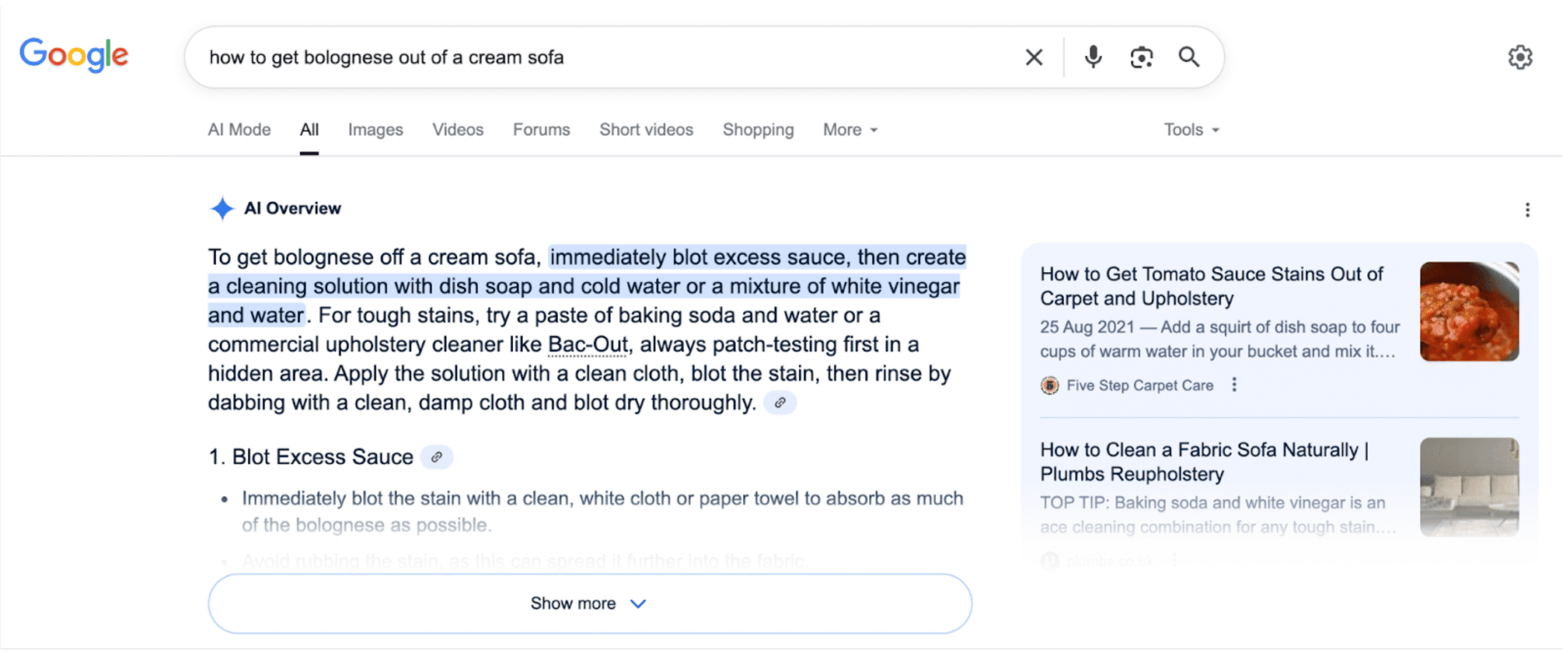
However, just because AI can spit out an answer faster to your query than you can say an expletive about dropping your pasta bowl, it doesn’t mean it should be doing all the heavy lifting when it comes to content creation for your website.
It may be really tempting to produce content, like blog articles and site landing pages using AI tools – after all, they can generate content in less time than it took for your pasta to cook.
Unfortunately, search engines aren’t that easily impressed. Google isn’t just looking for words on a page, it wants content that shows real experience, expertise, authority, and trustworthiness.
I will admit that yes, AI can summarise, reword, and sound a bit clever, but it can’t share the little hacks, relatable stories, or practical context that human written content can, the aspects of content that make it genuinely useful, unique and real.
That’s why human written content is still the real chef in the SEO kitchen.
What are the benefits of human written content?
Content written by real people shows Google there’s an actual brain behind the words on a website, not just a robot throwing spaghetti at the wall to see what sticks.
The quality, usefulness and uniqueness of your content affects everything, from which queries you rank for, whether your site gets chosen for AI Overviews, and ultimately the question of will real people actually bother to read and engage with your content.
AI can be a handy sous chef, potentially chopping ingredients and suggesting the right seasoning to use in the content preparation and production process, but humans are still the real chefs in the kitchen when it comes to writing content (even if we’re sometimes scraping bolognese off our sofa at ten past 9 on a Tuesday evening…).
So apart from telling you that Dr Beckmann upholstery stain remover with the little brush head is the best for removing red bolognese dye from your coach (you’re welcome), how do you balance using AI tools to help you and ensuring content is human written.
How do you use AI tools to help you but not take over the content writing process?
-Let AI assist with research, summarising, or brainstorming ideas – get your culinary juices flowing with it, but don’t let it take over the recipe.
-Focus on creating content that is clear, well structured, and genuinely helpful to your audience. No matter what the topic, consider logically what the user would potentially want to know.
-Avoid everyone’s favourite, copy and paste. At school when everyone discovered the joy of copy and paste we loved it, search engines not so much. Make sure to use your own tone of voice, insights, and experience into content. Don’t just copy and paste directly from AI tools.
-Sure, AI can generate content faster than I can whip up my latest ‘girl dinner,’ but it’s not going to earn me a Michelin star in Google’s eyes. Only good quality, human written content builds real authority, trust, and keeps your site competitive.
-AI tools can generate content faster than it takes Nigella Lawson to describe what she’s making, one woman, way too many adjectives. Instead of using them to write content, use it to speed up tasks like research, keyword suggestions, or summarising complex topics.
Final Word: AI can assist you, but only humans can write valuable content
At the end of the day, AI is a clever little sous chef there’s no denying it, but it can’t survive a bolognese incident or two the way a human can.
Only real people can add the insight, personality, and messy kitchen anecdotes, like my culinary adventures in making my tea, that Google actually values.
Use AI to help with research and brainstorming, but make sure it’s you, the human, creating content that’s genuinely valuable, and the philosophy behind our SEO services: human expertise doing the writing, AI doing the washing up.

Words by: Daisy Abraham
Content and Digital PR Manager
Daisy Abraham is a Content & Digital PR Manager here at SQUIDGY, with expertise in content marketing, brand storytelling and online outreach. Daisy writes about content strategy, digital PR campaigns and the latest trends in search and online visibility.